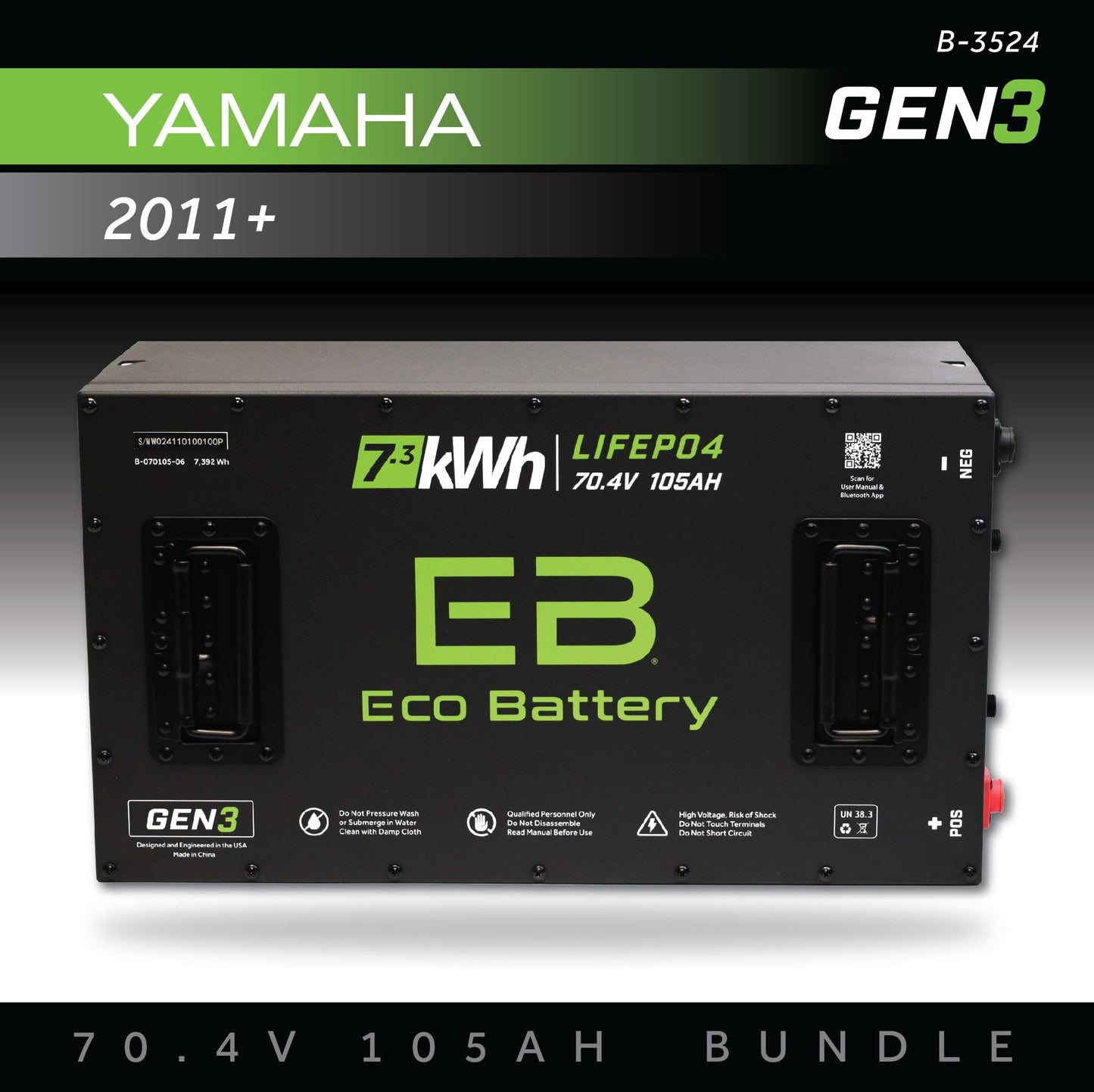
Eco Battery 70V 105AH Battery Bundle / Yamaha Drive 1 & 2 / 2011 - B-3524
Couldn't load pickup availability
Eco Battery 70V 105AH Battery Bundle / Yamaha Drive 1 & 2 / 2011 - B-3524
- A-070105-06 70V 105AH LiFePO4 Battery GEN3
- A-1071 70V 15A CAN Charger
- A-1272 DC-DC 12V Converter / 40V-90V Input
- A-3102 LCD State of Charge Meter
- A-4042 Yamaha Drive (2011+) Charge Port (Locking)
- A-8003 Battery Mounting Hardware / 5/16in
- A-8201 Eco Battery Mounting Kit / Yamaha Drive/G29 / 2011+
- A-4220 Remote Button Battery Wake Up Kit
What Our Experts Think
- The 70V 105Ah system is a high-performance upgrade for Yamaha Drive 1 & 2 (2011+) carts, delivering stronger torque, higher top-end stability, and extended runtime for demanding daily use or hilly terrain.
- Experts highlight the higher voltage architecture (70V) as a key advantage, providing more efficient power delivery and reduced current draw, which helps improve overall system longevity and performance under load.
- The 105Ah LiFePO₄ capacity (~7.3 kWh class energy system) supports long-range driving with fewer charging cycles, making it ideal for fleet use, large properties, or multi-passenger setups.
- Built on Eco Battery’s Gen3 smart BMS platform, the system provides real-time protection, cell balancing, and advanced communication, ensuring stable operation even under heavy acceleration or cargo loads.
- The complete bundle design includes charger, DC-DC converter, SOC gauge, charge port, and mounting hardware, enabling a clean OEM-style conversion with minimal compatibility issues.
- Installers frequently note noticeably improved hill-climbing performance and throttle response, especially when replacing aging lead-acid or lower-voltage lithium systems.
- The system is designed for plug-and-play integration with Yamaha Drive platforms, though experts recommend verifying controller and motor compatibility for maximum performance gains in upgraded carts.
Q&A
Q: What vehicles is the Eco Battery 70V 105AH bundle compatible with?
A: Designed for Yamaha Drive and Drive2 2011+ golf carts, providing a direct-fit lithium upgrade for 48V systems with performance headroom for modified carts.
Q: What is included in the Eco Battery 70V 105AH bundle?
A: The kit typically includes a 70V 105Ah LiFePO4 battery, CAN charger, DC-DC converter, SOC gauge, charge port, mounting hardware, and wake-up kit for a complete conversion.
Q: What performance benefits does this battery provide?
A: Delivers higher voltage output, stronger torque, improved hill-climbing ability, longer range, and more stable power delivery under heavy load compared to lead-acid setups.
Q: Is this good for lifted or heavy Yamaha carts?
A: Yes. The 105Ah capacity and high-voltage design make it ideal for lifted carts, larger tires, and heavier passenger or utility use.
Q: Does it support accessories and 12V systems?
A: Yes. The included DC-DC converter provides stable 12V power for lights, radios, USB ports, and other accessories.
Q: Is installation plug-and-play?
A: Yes. It comes with a cart-specific mounting system, labeled wiring, and OEM-style charge port for simplified installation.
Q: Why choose a 70V system over standard 51V lithium?
A: The higher-voltage platform reduces current draw, improves efficiency, and provides better performance under load, especially for upgraded motors and controllers.
Maintenance Tips
- Fully charge after each use to maintain peak 70V system performance and range.
- Avoid deep discharges below 10–15% to extend lithium battery lifespan.
- Use only Eco Battery approved 70V lithium charger for safe, balanced charging.
- Store at 40–70% charge in a cool, dry environment for long-term battery health.
- Inspect Yamaha Drive 1 & 2 (2011+) high-voltage cables, terminals, and connectors monthly.
- Keep battery tray and compartment clean, dry, and free of dust or corrosion.
- Monitor BMS or display readings regularly for voltage balance and early fault detection.
- Avoid heavy acceleration or hill climbing at low state-of-charge to reduce stress on cells.
- Ensure all mounting hardware is tight to prevent vibration damage in utility or fleet use.
- Perform periodic full charge cycles to help maintain accurate state-of-charge calibration.